The book is a collection of short stories so there isn’t any one idea that inspired
Electricity. If anything, it is the result of taking a unique path into adulthood after I graduated from college. I did everything I could to avoid a common life and there are some pitfalls that likely occur with such a choice. Every one of the stories is a coming-of-age tale, but each story has a different source of inspiration. With many stories I want to answer a question. Sometimes I want to challenge an idea. Whatever the inspiration, every story is part exploration. That’s how I think of writing in general; it’s an exercise in discovery.
Two of the stories in
Electricity are YA stories that reflect the challenges young people face in their journey to adulthood when, in fact, the adult lives they witness seem so thoroughly demented. Because it’s true isn’t it? For all that we can say about growing up and maturing, our adult peers are often the worst role models. And I’m not just talking about the bad parents. I look at my middle aged peers (self included) and see habitual behavior, heavy reliance on stability over the joy of discovery, and grouping behaviors that lead to division and loneliness rather than shared enlightenment. The other three stories focus on the new adult years of life, that time when we put our ideals and philosophies into the game, so to speak, and see how they really play out. What an exciting time. What a hard time, too. All that freedom, all that maturing and intellectual development (or lack of) can make every moment so vivid it’s hard not to be excited. These were times in my life that served up great opportunities for storytelling. So new to the world, our personal characters are going to be challenged at every turn.
About The Book:
Title:
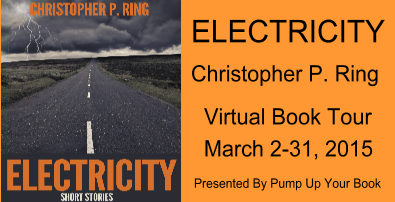
Electricity
Author: Christopher P. Ring
Publisher: Independent Self Publishing
Publication Date: December 5, 2014
Pages: 73
ASIN:
B00QOBEIX4
Genre: Literary / New Adult / Short Stories Collection
Format: eBook (.mobi / Kindle), PDF
Buy The Book:
Book Synopsis:
A teenager wrestles with the meaning of love when his parent’s high-voltage marriage turns deadly. School boys playing chicken with a commuter train, search for answers about life and death. An American teacher working in Peru struggles to reconcile the gap between her idealism and the reality of poverty when an act of kindness leads to a frightening episode. Covert baptisms, duels of love and highway robberies: the coming-of-age stories in
Electricity share a vision of America marked by tainted innocence and misguided idealism.
Book Excerpt:
But Licho remains tall. Scanning the horizon of the classroom, his
hand blocks out an imagined sun. Micah
follows his vision across the walls.
They are tacked with pictures she has torn from history books and
language books. There are pictures of
Quechua farmers from the hills re-enacting ancient Inca dances for Inti-Ramin,
and next to those, pictures of Gene Kelly and Audrey Hepburn dancing on the
Seine in Paris. On the back wall there
are pictures of conquistadors and ancient emperors, Pizarro paired with
Atahualpa, Cortez paired with Pachacutec. And then Licho’s face expresses the
consternation of a soldier under attack.
“Look,
Injuns,” Licho calls, pointing over Micah’s head. “Man the fart.”
She
laughs. “It’s fort.”
“Fort!”
he says. “Man the fort!”
He
leaps off the desk and runs for the far wall.
Then he comes back slowly, touching the ground and smelling his hand,
like an Indian tracking an animal. This,
from a man who kills pigs and tars roads.
Nothing seems to phase him. Yet,
she knows she would starve if she had to do these same things to feed herself.
“I
thought you worked nights only?” Micah asks.
“What happened to work tonight?”
Licho
leaps to her desk and scurries across it like a crab.
“Stop
it Licho. What happened?”
“No
work,” he says, falling backwards into her desk chair. It groans as he slides backwards. Suddenly he seems sullen. “How do you say in Amer-eeca. Fried?”
“You
got fired!”
“Now
you.”
Licho
springs to his feet and nudges Micah towards the stack of chairs. “Now you.
Tell what you see.” He slides the
desk closer and jerks his head in an upward motion.
“No,”
she says, listlessly.
“Vengas. I will hold chairs.”
She
feels silly doing this, but thinks she owes it to him. After all, he has given up the afternoon,
reading to one group while she read with another. And she has seen a world he has not seen, a
world he wants to see, and she feels sorry.
Yet, this is what scares her. She
is afraid of what he might expect; with her, he could escape it all. She climbs on to the desk and feels his hands
pushing and holding her waist at the same time.
The stack of chairs is a teetering ladder and for a moment, looking down
on him, Licho seems small.
“What
do you see?” he yells out to her excitedly.
Shhh! Micah puts a finger to her lips. The principal is in his office a few rooms
down the line from hers. Micah should be
gone already. With a free hand she grabs
at the tiled windowsill. The moon is
streaking down across the courtyard, the dirt pale and white like dried bones.
“I
see the moonlight,” she says. “And
dirt. And a pencil in the moonlight.”
“Si,
si. More. What else?”
“Nothing.” The game feels silly. She is thirty, not twenty-one. What she has seen in Peru has made it hard to
pretend. If she really wants to look,
she already knows what she will see - the things she has not been able to look
beyond. Alcoholics littering the streets
with empty bottles of rubbing alcohol, stray dogs, piles of garbage clogging
the river, four year old children selling candy, dirty children, poverty. A city still recovering from an earthquake
twenty years earlier. Decay. “Nothing,” she retorts.
“Liar. Let me look.
I will show. I can see.”
From
her perch the emptiness of her classroom seems out of tune with the life her
students bring. Licho reaches up for her
hand and pulls her down. His hand goes
up the back of her shirt and it pinches her.
She stiffens.
“That
hurt,” she says.
“Sorry.” He puts one hand to his lips, reaches out
with the other. His finger tips are
coated in tar, small pebbles dried into them.
“No com off.”
Micah
relaxes. It is his right to imagine, to
hope for something better. He has
dreams, damn it. They, too, must
pinch. She can still feel where his hand
touched her, perhaps as much as he had hoped for, but she gives him a shoulder
and helps him up. He rises against the
glow of the window.
There
is silence.
“Hmm,”
he says. “Oh yes. I see.”
Licho
talks about getting a job as a handyman in an apartment building in
Denver. He paints dreams of ten hour
work days and coming home to sit on a balcony that overlooks the freeway, and
sipping Pisco Sour’s. A movie theater is
a block away and there are three markets on the corner. Nothing changes in his America but the
numbers. There are more jobs, more cars,
twice as many food stands, trains and buses going to more places, elections
every week. Micah stands by the door and
looks out.
“Maybe
you have apartamento on other side of road.
We sit on balcony and wave to each other after work. Maybe you com over. We have ceviche or
MeecDonald’s. Yes, I see.” He looks at Micah in the doorway and
squints. “You see, yes?”
He
climbs down and turns her towards the stack of chairs. “I show you,” he says. She can feel his hands against her ribs as he
urges her to climb again, but she doesn’t want to. This is unrealistic. It is a fantasy she knows not to encourage,
yet she does not want to break it. She
grabs the edge of a chair and resists.
With her legs she pushes back against Licho. She feels the back of her head knock into his
teeth.
“Puta!”
he says, pinning her with his rough hands.
The stack slides up against the window sill. Down the hill there are people working and
walking the streets, but they are miles away at this point.
“Mentirosa!”
he spits. Liar. Micah is gated between his arms and the
chairs and she can feel his breath on her neck.
Its sweet smell of cola mixes with the dried tar on his shirt. Twisting her by the arms he wrenches her
loose as the chairs topple over in a big crash.
The small room is split in half by the meager courtyard light. Where they stand by the desk the light is
soft and dusty, but the far end by the doorway is darkness. She winds her way through the fallen desks,
stepping on markers and crayons that she had to purchase with her own
money. Holding close to the back wall
Micah finds herself crossing out of the light, but away from the doorway. She remembers the old woman squatting on the
corner a few days earlier whom he had scolded, swatted at the woman’s head with
a rag he was carrying. “Puerco,” he’d
said. Pig. She’d gotten mad at him for that, though at
the time it seemed innocent. A woman
should not have to see that, he’d said.
“Puta,”
he calls over softly, leaning into the desk.
The single drawer is open. In his
hand he is waving something, her passport.
For a moment her breath is paralyzed.
Discuss this book in our PUYB Virtual Book Club at Goodreads by clicking HERE
About The Author:
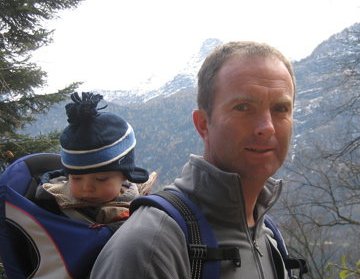
Christopher P. Ring writes fiction, poetry, children’s stories, travel essays, social commentaries, humor and screen plays. His writing has appeared in numerous regional magazine and small literary journals such as Caldera and The Broken Bridge Review. He received his Master’s Degree in Creative Writing from the University of New Hampshire and taught High School English for several years in the U.S. and abroad. He continues to teach the art storytelling to Elementary school students in Southern Maine, where he resides with his wife (a teacher too) and two children.
Much of his fiction draws on the experiences and discoveries of his life as a “rambler”. Growing up in Long Island, New York, he developed an insatiable thirst to escape the confines of conventional living, spending his twenties and early thirties travelling the globe to off the beaten path places in search of adventure. He has called many regions of the U.S. his home and has also lived in Ireland, the Andes of Colombia, and Vienna, Austria. As with the cultures and places he has visited, the settings in his story shape the events and characters profoundly.
You can learn more about Christopher P. Ring and check out other writing of his at
www.mortalsandfools.com.
His next book,
The Glow, a collection of speculative fiction short stories, will be available in April, 2015.
Connect with Christopher:
Author Website:
www.mortalsandfools.com
Author Blog:
www.mortalsandfools.com
Twitter:
https://twitter.com/untermarmot
Goodreads:
https://www.goodreads.com/author/show/13084642.Christopher_P_Ring