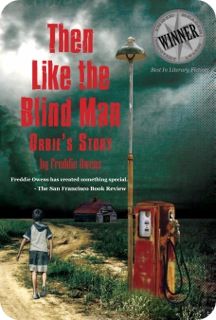
Hello all! Freddie Owens here, coming to you from the blogosphere,
which in reality is an oversized closet with squares of burgundy foam
glued to the walls for sound absorption. That’s it, that’s what the
blogosphere is, or at least how I imagine it to be all over the world,
closets everywhere populated by The Lone Rangers of Hope and Fear, i.e.,
bloggers of the existential and the mundane, of the profound, the funny
and the ‘give me a break’. Anyway – this post on Authonomy is inspired
by the need to get the message out about my debut novel
Then Like the Blind Man: Orbie’s Story.
After many years of ‘almost’ and ‘no’ or ‘yes but we wouldn’t know how
to market it’ from agents and publishers alike, I’ve opted
for ‘certainly’ and ‘yes’ instead, taking all my marbles to Amazon and
my unincorporated Blind Sight Publications, the phantom home of
Blind Man.
I was born in Kentucky but grew up around Detroit. I would sometimes
spend a week or two, once I spent six weeks, in Kentucky, staying with
cousins or with my grandparents. And yes, it was an entirely different
world for me, providing some of the best and worst times of my growing
up years. I had a great time on a dairy farm with several of my cousins,
milking cows, hoeing tobacco, running over the hills and up and down a
creek that surrounded the big farm. I remember too, periods of abject
boredom, sitting around my grandparent’s place with nothing to do but
wander about the red clay yard or kill flies on my grandmother’s
screened in back porch. Some of this did come out in the novel.
In the novel’s acknowledgements I assert the usual disclaimers having to do with the fact that
Then Like The Blind Man
was and is a work of fiction, i.e., a made up story whose characters
and situations are fictional in nature (and used fictionally) no matter
how reminiscent of characters and situations in real life. That’s a
matter for legal departments, however, and has little to do with
subterraneous processes giving kaleidoscopic-like rise to hints and
semblances from memory’s storehouse, some of which I selected and
disguised for fiction. That is to say, yes, certain aspects of my
history did manifest knowingly at times, at times spontaneously and
distantly, as ghostly north-south structures, as composite personae, as
moles and stains and tears and glistening rain and dark bottles of beer,
rooms of cigarette smoke, hay lofts and pigs. Here’s a quote from the
acknowledgements that may serve to illustrate this point.
“Two memories served as starting points for a short story I wrote
that eventually became this novel. One was of my Kentucky grandmother as
she emerged from a shed with a white chicken held upside down in one of
her strong bony hands. I, a boy of nine and a ‘city slicker’ from
Detroit, looked on in wonderment and horror as she summarily wrung the
poor creature’s neck. It ran about the yard frantically, yes incredibly,
as if trying to locate something it had misplaced as if the known world
could be set right again, recreated, if only that one thing was found.
And then of course it died. The second memory was of lantern light
reflected off stones that lay on either side of a path to a storm cellar
me and my grandparents were headed for one stormy night beneath a
tornado’s approaching din. There was wonderment there too, along with a
vast and looming sense of impending doom.”
I read the usual assigned stuff growing up, short stories by Poe,
The Secret Life of Walter Mitty,
The Scarlet Letter,
The Cherry Orchard,
Hedda Gabler,
a little of Hemingway, etc. I also read a lot of Super Hero comic books
(also Archie and Dennis the Menace) and Mad Magazine was a favorite
too. I was also in love with my beautiful third grade teacher and to
impress her pretended to read
Gulliver’s Travels for which I received many delicious and ill-deserved hugs.
It wasn’t until much later that I read
Huckleberry Finn. I did read
To Kill A Mockingbird too. I read
Bastard Out of Carolina and
The Secret Life of Bees. I saw the stage play of
Hamlet and read
The Story of Edgar Sawtelle too. However, thematic similarities to these works occurred to me only after I was already well into the writing of
Then Like The Blind Man.
Cormac McCarthy, Pete Dexter, Carson McCullers, Raymond Carver,
Flannery O’Conner and Joyce Carol Oates, to name but a few, are among my
literary heroes and heroines. Tone and style of these writers have
influenced me in ways I’d be hard pressed to name, though I think the
discerning reader might feel such influences as I make one word follow
another and attempt to “stab the heart with…force” (a la Isaac Babel) by
placing my periods (hopefully) ‘… just at the right place’.
———————————

A poet and fiction writer, my work has been published in
Poet Lore,
Crystal Clear and Cloudy, and
Flying Colors Anthology.
I am a past attendee of Pikes Peak Writer’s Conferences and the
Association of Writers and Writing Programs, and a member of Lighthouse
Writer’s Workshop in Denver, Colorado. In addition, I am/was a licensed
professional counselor and psychotherapist, who for many years counseled
perpetrators of domestic violence and sex offenders, and provided
psychotherapy for individuals, groups and families. I hold a master’s
degree in contemplative psychotherapy from Naropa University in Boulder,
Colorado.
I was born in Kentucky but soon after my parents moved to Detroit.
Detroit was where I grew up. As a kid I visited relatives in Kentucky,
once for a six-week period, which included a stay with my grandparents.
In the novel’s acknowledgements I did assert the usual disclaimers
having to do with the fact that
Then Like The Blind Man was and
is a work of fiction, i.e., a made up story whose characters and
situations are fictional in nature (and used fictionally) no matter how
reminiscent of characters and situations in real life. That’s a matter
for legal departments, however, and has little to do with subterranean
processes giving kaleidoscopic-like rise to hints and semblances from
memory’s storehouse, some of which I selected and disguised for fiction.
That is to say, yes, certain aspects of my history did manifest
knowingly at times, at times spontaneously and distantly, as ghostly
north-south structures, as composite personae, as moles and stains and
tears and glistening rain and dark bottles of beer, rooms of cigarette
smoke, hay lofts and pigs. Here’s a quote from the acknowledgements that
may serve to illustrate this point.
“Two memories served as starting points for a short story I wrote that eventually became this novel. One was of my Kentucky
grandmother as she emerged from a shed with a white chicken held upside
down in one of her strong bony hands. I, a boy of nine and a “city
slicker” from Detroit, looked on in wonderment and horror
as she summarily wrung the poor creature’s neck. It ran about the yard
frantically, yes incredibly, as if trying to locate something it had
misplaced as if the known world could be set right again, recreated, if
only that one thing was found. And then of course it died. The second
memory was of lantern light reflected off stones that lay on either side
of a path to a storm cellar me and my grandparents were headed for one
stormy night beneath a tornado’s approaching din. There was wonderment
there too, along with a vast and looming sense of impending doom.”
I read the usual assigned stuff growing up, short stories by Poe,
The Secret Life of Walter Mitty,
The Scarlet Letter,
The Cherry Orchard,
Hedda Gabler,
a little of Hemingway, etc. I also read a lot of Super Hero comic books
(also Archie and Dennis the Menace) and Mad Magazine was a favorite
too. I was also in love with my beautiful third grade teacher and to
impress her pretended to read
Gulliver’s Travels for which I received many delicious hugs.
It wasn’t until much later that I read
Huckleberry Finn. I did read
To Kill A Mockingbird too. I read
Bastard Out of Carolina and
The Secret Life of Bees. I saw the stage play of
Hamlet and read
The Story of Edgar Sawtelle too. However, thematic similarities to these works occurred to me only after I was already well into the writing of
Then Like The Blind Man.
Cormac McCarthy, Pete Dexter, Carson McCullers, Raymond Carver,
Flannery O’Conner and Joyce Carol Oates, to name but a few, are among my
literary heroes and heroines. Tone and style of these writers have
influenced me in ways I’d be hard pressed to name, though I think the
discerning reader might feel such influences as I make one word follow
another and attempt to “stab the heart with…force” (a la Isaac Babel) by
placing my periods (hopefully, sometimes desperately) ‘… just at the
right place’.
Freddie Owens’ latest book is
Then Like the Blind Man: Orbie’s Story.
Visit his website at
www.FreddieOwens.com.
 The initial idea for the book came from a combination of learning
about the sacred time-honored art of Japanese tentacle porn (from
Anthony Bourdain’s travel show, not from me searching for porn on Google
– honest!) and as-yet-unconfirmed reports of freshwater octopi in
certain lakes in
Oklahoma. From that concept, it was simply a matter of inserting (pun
intended) a sexually skilled and amorous octopus into the lives of the
characters one might actually find in a small-town community in Central
Texas. While the characters in the book are all fictional, some were
created with certain real-life people in mind.
The initial idea for the book came from a combination of learning
about the sacred time-honored art of Japanese tentacle porn (from
Anthony Bourdain’s travel show, not from me searching for porn on Google
– honest!) and as-yet-unconfirmed reports of freshwater octopi in
certain lakes in
Oklahoma. From that concept, it was simply a matter of inserting (pun
intended) a sexually skilled and amorous octopus into the lives of the
characters one might actually find in a small-town community in Central
Texas. While the characters in the book are all fictional, some were
created with certain real-life people in mind. Fletcher Best is an American author of humorous fiction and science fiction. He is the author of the Stranded In Time series of science fiction novels, including Pirates of the Storm, The Corpornation, and the upcoming third installment, Timeless. His humorous works include Sniffing Out Stink Ape, The Great Chupacabra Kerfuffle, and The Eight Fingered Fiend of Lake Porker.


